Two Frameworks. One Approach to Transformation.
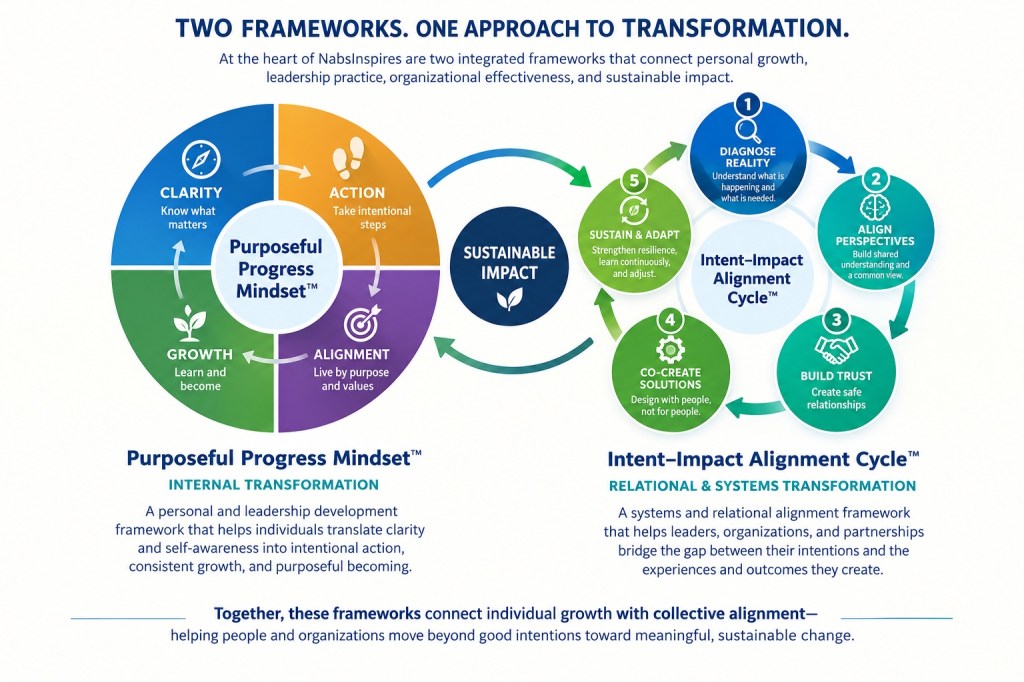
Connecting Personal Growth, Leadership Practice, Organizational Effectiveness, and Sustainable Impact.
At the heart of NabsInspires are two integrated signature frameworks that guide how we understand growth, approach challenges, develop people, strengthen organizations, and pursue meaningful change.
The Purposeful Progress Mindset™ focuses on internal transformation: helping individuals gain clarity, make intentional choices, pursue opportunities, and grow into who they want to become.
The Intent–Impact Alignment Cycle™ focuses on relational and systems transformation: helping leaders, organizations, and partnerships close the gap between what they intend to achieve and the experiences and outcomes they actually create.
Together, these frameworks connect individual growth with collective alignment—helping people and organizations move beyond good intentions toward meaningful, sustainable change.
01. THE PURPOSEFUL PROGRESS MINDSET™
Small, Intentional Steps. Big, Lasting Impact.
The Purposeful Progress Mindset™ is a personal and leadership development framework designed to help individuals move beyond temporary motivation and achievement-driven thinking toward a more intentional, sustainable, and meaningful approach to growth.
At its core is a simple but powerful belief: lasting transformation is not simply about what you accomplish. It is about how you grow, what sustains your progress, and who you become along the way.
Many people begin their growth journeys with ambition, motivation, and clear goals. Yet maintaining progress can become difficult when life gets challenging, setbacks occur, priorities compete, or results take longer than expected.
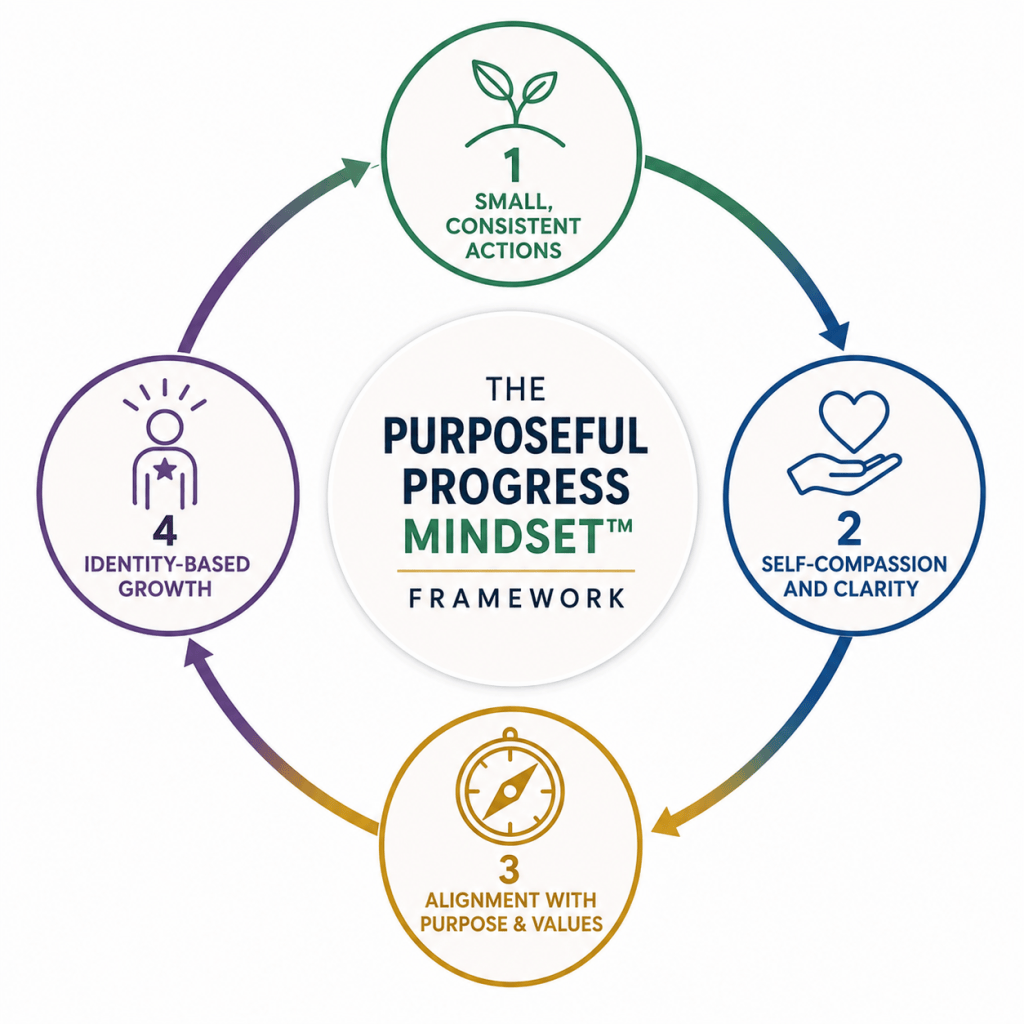
The Purposeful Progress Mindset™ addresses this challenge through four interconnected anchors that support sustainable growth.
These anchors help individuals build consistency, respond to themselves with greater understanding, remain connected to their purpose and values, and develop an identity that supports continued growth.
The Four Anchors of the Purposeful Progress Mindset™
01. Small, Consistent Actions
Transformation begins with repetition, not intensity.
Real transformation does not necessarily begin with dramatic decisions or extraordinary bursts of motivation. It begins with small actions repeated consistently over time.
This anchor focuses on building momentum through manageable, intentional steps rather than depending on temporary motivation.
It recognizes that sustainable progress is often the result of ordinary actions performed consistently, even when circumstances are not ideal.
The emphasis is on:
- Building habits through repetition.
- Taking manageable steps toward meaningful goals.
- Developing consistency rather than relying on motivation.
- Recognizing and appreciating incremental progress.
- Maintaining momentum through changing circumstances.
The guiding principle: Consistency turns intention into transformation.
02. Self-Compassion and Clarity as a Growth Strategy
How you treat yourself during struggle influences whether you continue or quit.
Growth is not always comfortable or predictable. There will be setbacks, uncertainty, mistakes, and moments when progress feels difficult.
Without emotional safety and an honest understanding of what is happening, consistency can become difficult to maintain.
This anchor brings together two essential elements: self-compassion and clarity.
Self-compassion is not about lowering standards, avoiding responsibility, or making excuses. It is about removing unnecessary self-punishment from the growth process while maintaining the ability to recognize what needs to change.
Clarity helps you understand your circumstances accurately rather than allowing disappointment, frustration, or fear to turn a setback into a perceived failure.
Together, they help individuals respond to challenges more constructively.
The emphasis is on:
- Recognizing setbacks without defining yourself by them.
- Developing a healthier relationship with mistakes and imperfections.
- Understanding emotional responses and personal patterns.
- Distinguishing temporary difficulties from permanent conclusions.
- Responding to challenges with honesty, patience, and responsibility.
- Learning what needs to change without abandoning the process.
The guiding principle: Clarity helps you understand where you are. Self-compassion helps you continue from there.
03. Alignment with Purpose & Values
Not all progress is meaningful progress.
You can accomplish goals, meet expectations, and achieve external success while still feeling disconnected from what truly matters to you.
This anchor emphasizes the importance of ensuring that your effort, decisions, and direction reflect your deeper sense of purpose and personal values.
It encourages individuals to examine whether they are pursuing what genuinely matters or simply responding to external expectations, social pressure, recognition, or the desire to satisfy others.
Alignment brings direction to effort and greater meaning to achievement.
The emphasis is on:
- Understanding what genuinely matters.
- Identifying personal values and priorities.
- Making decisions consistent with purpose.
- Recognizing when external expectations are driving choices.
- Aligning daily actions with long-term aspirations.
- Pursuing success that feels meaningful rather than merely impressive.
The guiding principle: Progress becomes meaningful when your actions reflect what matters most.
04. Identity-Based Growth — Identity Over Outcome
Sustainable change is not just about what you achieve. It is about who you are becoming.
Many people approach personal development by focusing primarily on outcomes: losing weight, getting promoted, earning more, completing a goal, or achieving recognition.
While outcomes can be important, lasting transformation requires something deeper.
It involves developing an identity that supports the behaviors, decisions, and commitments necessary for continued growth.
Instead of asking only:
What do I need to achieve?
Begin asking:
Who am I becoming through this process?
This shift changes how individuals approach their goals. They begin to see themselves as people who learn, adapt, take responsibility, and continue growing—not simply people chasing a particular result.
The emphasis is on:
- Developing an identity consistent with desired growth.
- Becoming someone who practices consistency.
- Recognizing that setbacks do not define personal identity.
- Building confidence through repeated intentional behaviors.
- Shifting from temporary performance to lasting personal development.
- Embracing growth as part of how you live and lead.
The guiding principle: Lasting transformation happens when growth becomes part of who you are, not just something you are trying to accomplish.
How the Four Anchors Work Together
The Purposeful Progress Mindset™ functions as an integrated system, not a collection of separate ideas.
Each anchor strengthens a different dimension of sustainable growth.
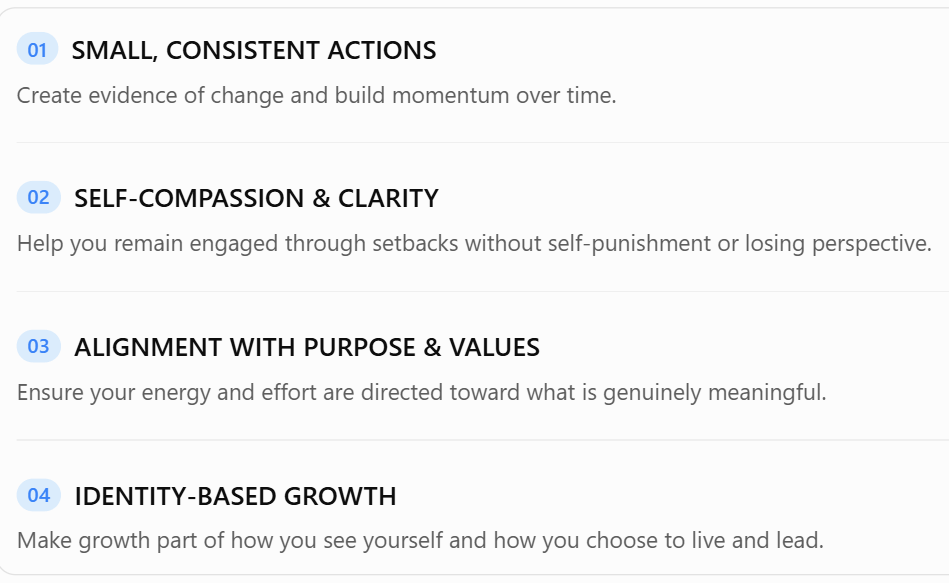
When any one of these anchors is weakened, progress can become harder to sustain.
- Consistency without self-compassion can become rigid and exhausting.
- Self-compassion without clarity can become an excuse to avoid necessary change.
- Action without purpose can lead to achievement without fulfillment.
- Goals without identity-based growth can produce temporary results without lasting transformation.
When all four anchors work together, growth becomes more sustainable, coherent, and deeply integrated into how you live and lead.
From Performing Progress to Embodying Progress
Understanding the framework is the beginning, not the destination.
The real shift happens when you stop treating growth as something you occasionally pursue and begin incorporating it into how you think, make decisions, respond to challenges, and live your life.
You no longer depend entirely on motivation to move forward. You develop consistency.
You no longer interpret every setback as failure. You learn to respond with clarity and self-compassion.
You no longer measure progress solely by external achievements. You become more intentional about alignment with your purpose and values.
And you no longer focus exclusively on what you want to achieve. You become increasingly conscious of who you are becoming.
Because understanding the system is not enough.
The real transformation begins when you stop trying to perform progress—and begin to embody it.
The guiding principle: Learn and become.
The Three C’s of Purposeful Progress™
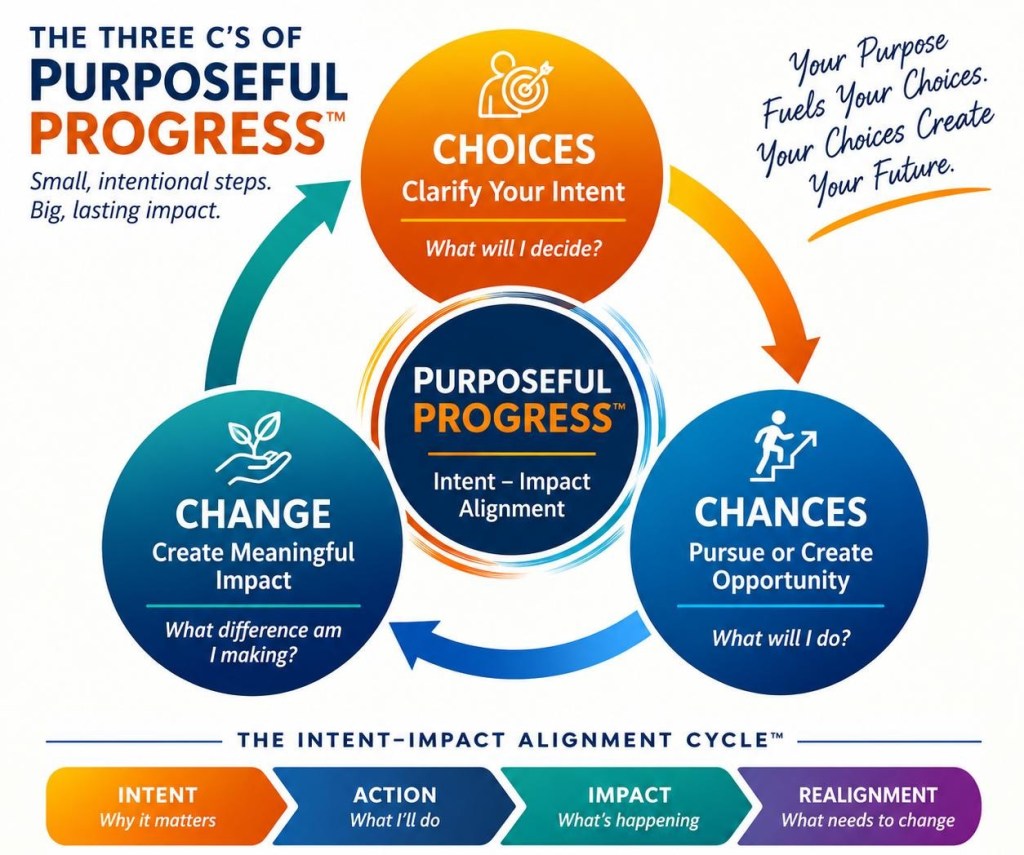
The Purposeful Progress Mindset™ is also brought to life through three memorable ideas: Choices, Chances, and Change.
These three C’s translate the framework’s philosophy into questions that encourage intentional living and meaningful action.
1. CHOICES — Clarify Your Intent
What will I decide?
Our choices influence the direction of our lives.
Every day, we make decisions about our priorities, relationships, opportunities, responsibilities, and the paths we pursue.
Purposeful progress begins when we become more conscious of those decisions and consider whether they reflect what genuinely matters.
The emphasis is on moving from automatic responses to intentional choices.
2. CHANCES — Pursue or Create Opportunity
What will I do?
Opportunities do not always arrive in the form we expect. Sometimes we recognize an opportunity already available to us; at other times, we must take initiative and create one.
This dimension encourages individuals to act on their intentions, embrace possibilities, take constructive risks, and move beyond the limitations of waiting for perfect conditions.
It is about recognizing that progress often requires initiative.
3. CHANGE — Create Meaningful Impact
What difference am I making?
Choices and opportunities become meaningful when they contribute to positive change.
This dimension encourages individuals to look beyond activity and consider the difference their decisions and actions are making in their lives, relationships, communities, and wider environments.
Change is not simply about doing something differently. It is about creating meaningful progress that reflects one’s purpose.
The Three C’s in One Statement
Your Purpose Fuels Your Choices. Your Choices Create Your Future.
The Three C’s remind us that purposeful progress is not simply about what we hope to achieve. It is about the decisions we make, the opportunities we pursue or create, and the change we contribute to the world around us.
Where We Apply the Purposeful Progress Mindset™
This framework informs the personal and leadership development dimensions of NabsInspires.
- Coaching: Helping individuals discover purpose, gain clarity, examine limiting beliefs, and pursue meaningful goals.
- Leadership Development: Helping leaders align their values, decisions, and leadership behaviors.
- Personal Growth: Encouraging intentional choices, resilience, self-awareness, and continuous development.
- Speaking & Training: Challenging individuals and audiences to move from inspiration to purposeful action.
The central message:
Small, intentional steps can create meaningful progress. What matters is not simply where you want to go, but the choices you make along the way.
02. THE INTENT–IMPACT ALIGNMENT CYCLE™
RELATIONAL & SYSTEMS TRANSFORMATION
Bridging the Gap Between What We Intend and the Impact We Create.
Organizations and partnerships are rarely static. They are dynamic systems shaped by communication, interpretation, relationships, leadership decisions, organizational culture, and changing circumstances.
Even when individuals and organizations share a mission, they may interpret urgency, fairness, accountability, success, and sustainability differently.
These differences do not necessarily reflect a lack of commitment or integrity. They often emerge from different experiences, assumptions, expectations, funding pressures, cultural contexts, and historical realities.
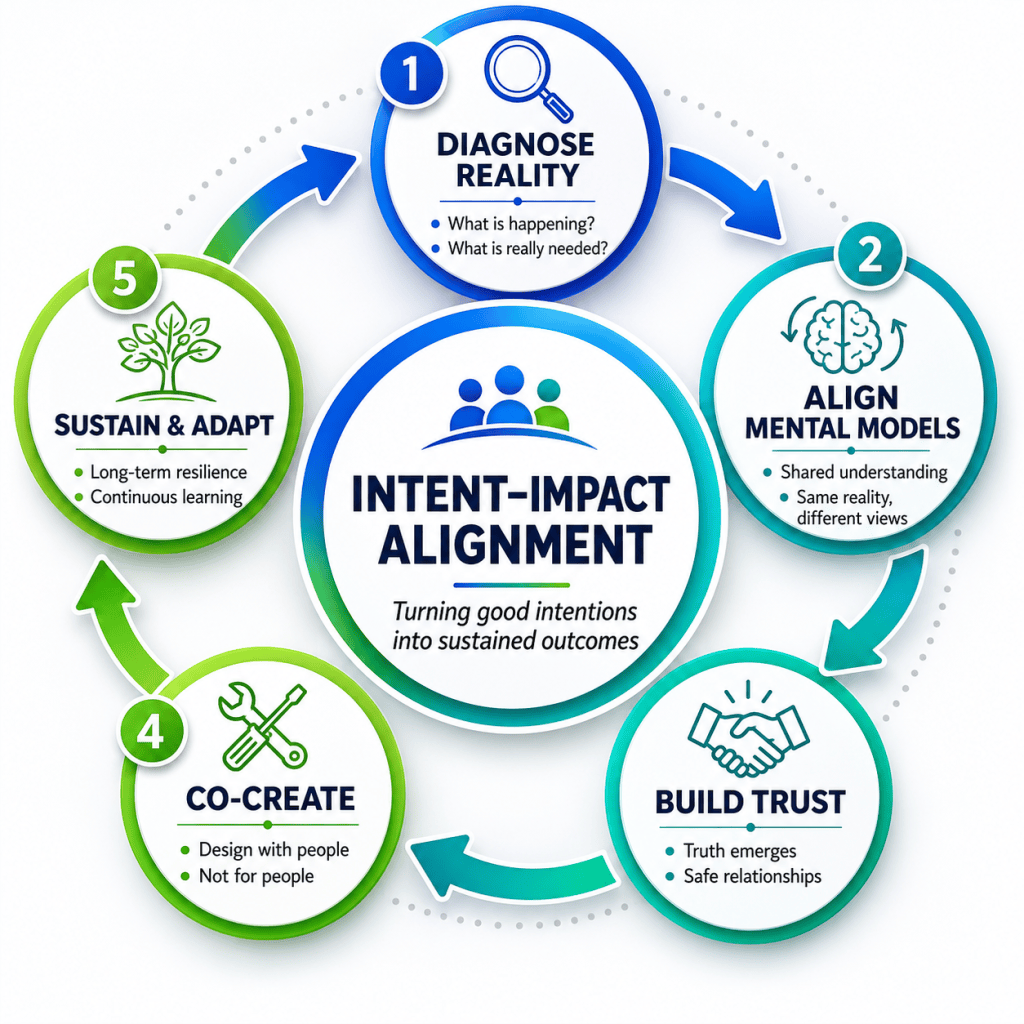
The Intent–Impact Alignment Cycle™ provides a structured approach to understanding these realities, developing shared understanding, strengthening trust, co-creating solutions, and continuously adapting systems to support meaningful and sustainable outcomes.
The central principle
Sustainable impact is not created by intention alone—but when reality is clearly understood, thinking is aligned, trust is built, solutions are co-created, and systems are continuously adapted over time.
The Five Stages of the Intent–Impact Alignment Cycle™
- Diagnose Reality — Understand what is happening and why it matters.
- Align Mental Models — Surface assumptions and develop shared understanding.
- Build Trust and Psychological Safety — Create conditions for honesty, learning, and openness.
- Co-Create Solutions — Design responses collaboratively rather than unilaterally.
- Sustain and Adapt — Learn, adjust, and strengthen alignment over time.
The Five Stages of Organizational and Relational Alignment
The four movements provide the overarching logic of the Intent–Impact Alignment Cycle™. In organizational and partnership settings, we translate that logic into five practical stages.
1. DIAGNOSE REALITY
Understand what is happening and what is needed.
Transformation begins with understanding the actual situation rather than relying on assumptions about what is happening.
This involves listening to stakeholders, examining organizational practices, identifying challenges, and understanding the experiences of those affected.
The objective is to establish an honest picture of reality before deciding what needs to change.
2. ALIGN PERSPECTIVES
Build shared understanding and a common view.
Different people may experience the same organization, initiative, or partnership in different ways.
This stage creates opportunities to clarify expectations, discuss different perspectives, identify shared priorities, and develop a common understanding of the desired direction.
Alignment does not require everyone to have identical opinions. It requires sufficient shared understanding to work constructively toward common objectives.
3. BUILD TRUST
Create safe relationships.
Trust enables people to communicate honestly, raise concerns, acknowledge mistakes, and participate meaningfully.
This stage focuses on strengthening relationships through transparency, consistency, mutual respect, communication, and accountability.
Without trust, even well-designed solutions may struggle to gain genuine commitment.
4. CO-CREATE SOLUTIONS
Design with people, not for people.
Sustainable solutions are strengthened when the people affected by them have a meaningful role in shaping them.
This stage emphasizes participation, shared responsibility, local knowledge, and contextually appropriate responses.
It is particularly important in cross-cultural partnerships and international development, where external intentions must be aligned with local realities and priorities.
5. SUSTAIN & ADAPT
Strengthen resilience, learn continuously, and adjust.
Transformation requires the ability to maintain progress while responding to changing circumstances.
This stage focuses on strengthening systems, reinforcing accountability, learning from experience, and adapting approaches when necessary.
The goal is to develop the capacity to sustain meaningful progress beyond a single project, intervention, funding cycle, or individual leader.
How the Five Stages Work Together
These five stages provide a practical way to move from understanding a challenge to developing and sustaining solutions.
They also recognize that organizational transformation is rarely linear.
For example, implementing a co-created solution may reveal new perspectives that require further alignment. Sustaining progress may uncover weaknesses in existing systems that require another round of diagnosis.
The cycle therefore encourages ongoing engagement, reflection, and adaptation.
Where We Apply the Intent–Impact Alignment Cycle™
This framework primarily informs the organizational, relational, and systems dimensions of NabsInspires.
- Organizational Advisory & Transformation: Strengthening governance, leadership alignment, accountability, organizational processes, and institutional capacity.
- Cross-Cultural Partnerships: Improving trust, communication, shared decision-making, and local ownership.
- Leadership Development: Helping leaders connect their intentions with their behavior and the experiences they create for others.
- Capacity Strengthening: Supporting collaborative problem-solving, organizational learning, and sustainability.
- Speaking & Training: Helping audiences understand why intentions must be supported by action, accountability, and continuous learning.
The central message:
The true measure of an intention is not simply what we say we want to achieve, but what people experience and the impact our actions create.
03. TWO FRAMEWORKS. ONE INTEGRATED APPROACH.
Connecting Personal Growth with Collective Transformation.
The Purposeful Progress Mindset™ and the Intent–Impact Alignment Cycle™ address two interconnected dimensions of meaningful transformation.
The first asks individuals to look inward: What matters? What choices am I making? What opportunities can I pursue or create? How am I growing?
The second asks leaders and organizations to look at the relationships and systems around them: What are we intending? What are we doing? What impact are we creating? What needs to change?
Both begin with intentionality. Both emphasize action. Both require reflection and alignment. And both recognize that meaningful progress requires continuous learning.
How the Frameworks Connect
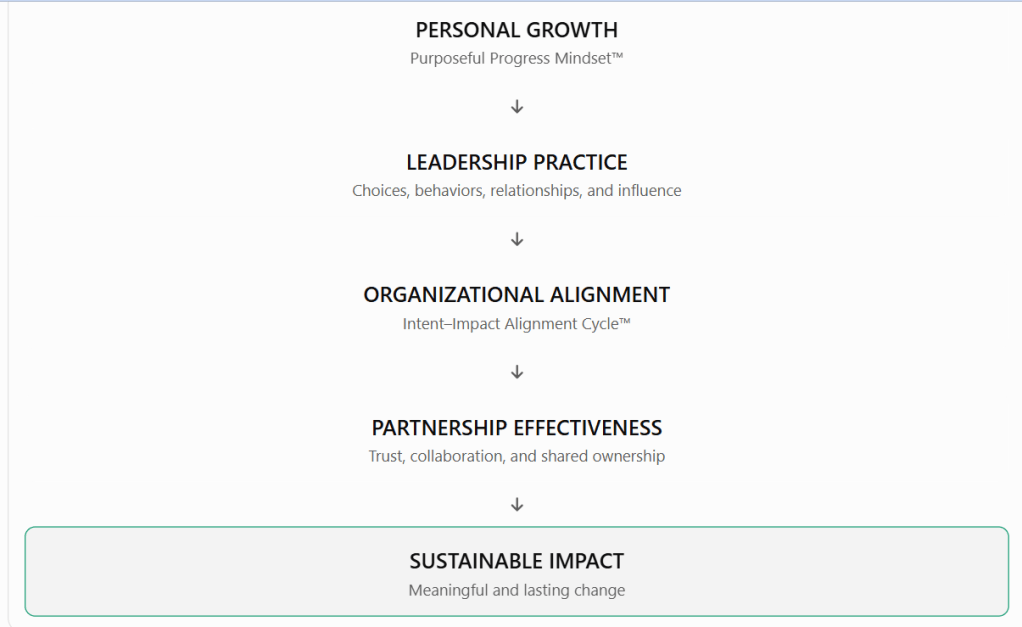
Beyond Inspiration. Toward Transformation.
NabsInspires exists to help individuals discover purpose, leaders lead with intention, and organizations translate their mission into meaningful and sustainable impact.
The Purposeful Progress Mindset™ reminds us that transformation begins with clarity, intentional choices, alignment, and growth.
The Intent–Impact Alignment Cycle™ reminds us that meaningful impact requires us to examine reality, align perspectives, build trust, co-create solutions, and continuously adapt.
Together, these frameworks represent our commitment to connecting personal development with leadership practice and organizational transformation.
Ready to Put Purpose Into Progress?
Whether you are seeking personal growth, developing your leadership capacity, strengthening an organization, or building more effective partnerships, explore how the NabsInspires approach can help you take the next step.

